Most companies begin their AI search with the wrong question:
Where can we use AI?
That question makes the technology the goal. It encourages teams to collect tools, launch disconnected pilots, and automate whatever looks easiest. The result may be an impressive demo, but it is rarely a meaningful business improvement.
A better question is:
What problem is worth solving—and what is the best way to solve it?
AI may be part of the answer. It may not. Either way, starting with the problem keeps the work grounded in value.
If you are trying to identify high-ROI AI use cases in your business, the following six-step process will help you move from vague enthusiasm to a solution people will actually use.
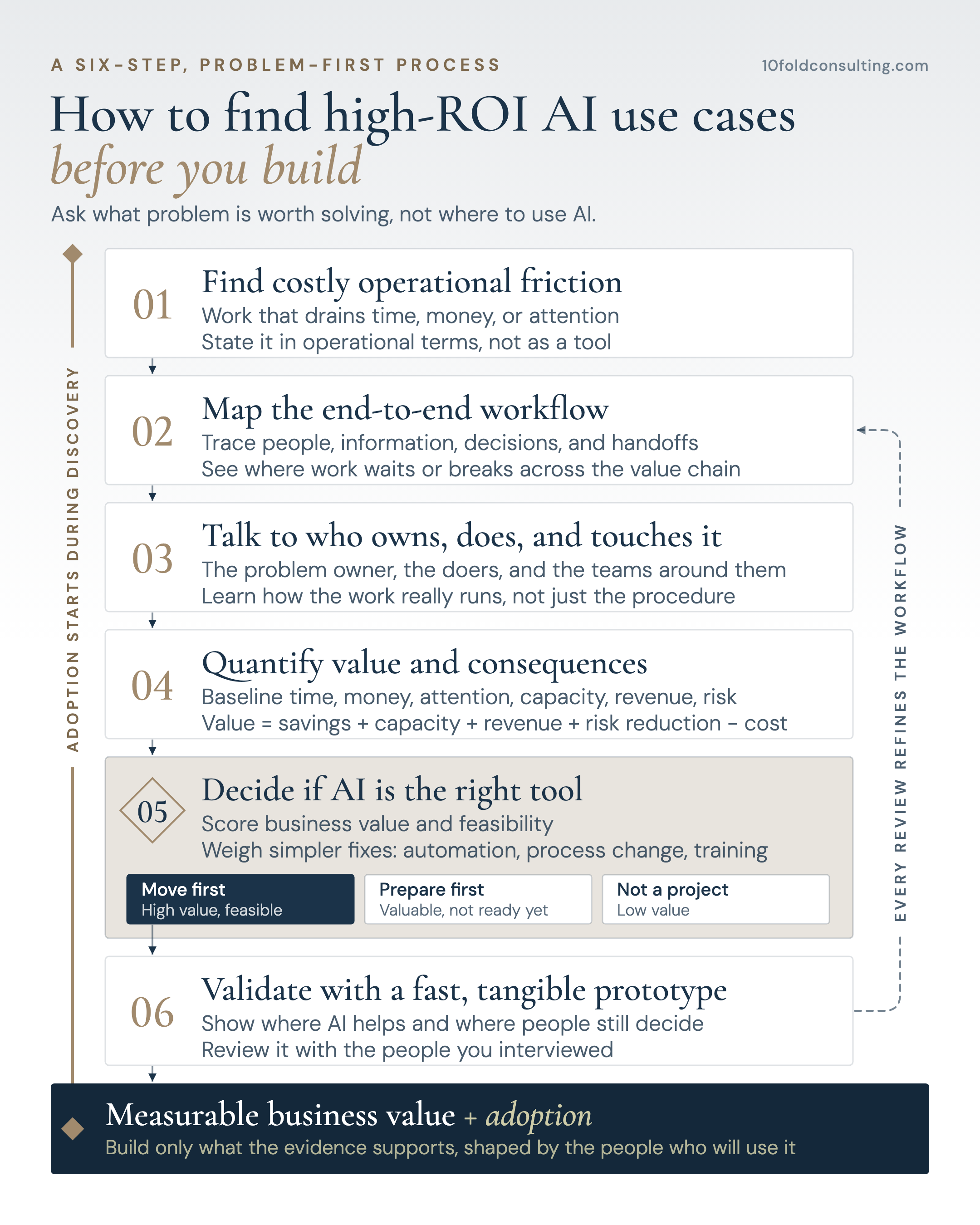
Jump to the six-step AI use-case flow chart for the full problem-first process at a glance.
1. Look for problems that consume time, money, or attention
The best AI opportunities usually begin as ordinary operational friction.
Look for work that:
- repeatedly consumes skilled employees' time;
- causes delays, rework, or avoidable errors;
- depends on searching across scattered information;
- creates a bottleneck between teams;
- prevents someone from focusing on higher-value work; or
- leaves revenue or capacity on the table.
Direct cost is only part of the calculation. Opportunity cost matters too. A process may take only five hours a week, but if those are five hours your best salesperson is not talking to prospects, the real cost is much larger than the payroll attached to the task.
Write the problem in operational language. For example:
Weak: We need an AI assistant for sales.
Stronger: Sales representatives spend three hours after each customer visit organizing notes, drafting follow-up, and updating the CRM. Follow-up is inconsistent and often delayed by several days.
The second statement gives you something you can measure and improve. It also leaves room for the right solution instead of forcing AI into the answer.
2. Map the workflow before choosing the technology
A business problem rarely lives in one task. It sits inside a chain of people, decisions, information, and handoffs.
Map the current workflow from trigger to result:
- What starts the work?
- Who receives it first?
- What information do they need?
- What decisions do they make?
- Where does the work wait, loop backward, or break?
- What must happen before the next person can act?
- What does “done” actually mean?
Then examine the upstream and downstream effects. If you improve this step, does it make the next team faster? Does it reduce the information the previous team must collect? Does it improve the customer's experience, the quality of a decision, or the speed of delivery?
This is where a small automation can reveal a much larger opportunity. It is also where apparently simple projects expose hidden complexity. An AI implementation should improve the whole value chain, not make one isolated task faster while moving the burden somewhere else.
Microsoft's AI strategy guidance similarly recommends turning each business problem into a statement that names both the activity and the expected result. Start with the business outcome before debating models, vendors, or architecture.
3. Talk to the people who own, do, and touch the work
Workflow diagrams are useful, but they are not the work itself.
You need input from three kinds of stakeholders:
- The problem owner: accountable for the outcome, budget, or risk.
- The person doing the work: understands the exceptions, shortcuts, and practical constraints.
- The people around the work: supply information, receive the output, review decisions, or absorb mistakes.
Each sees a different problem.
A CEO may know a department is too slow. A manager may know approvals are the bottleneck. A frontline employee may know the real delay comes from missing information at intake. A downstream team may reveal that the “finished” output is unusable without manual cleanup.
Ask questions that uncover how the system behaves, not just how the procedure says it should behave:
- Why is the work done this way today?
- Where do you leave the official process?
- What cases require judgment?
- What information do you routinely have to chase down?
- What errors are expensive or difficult to reverse?
- What would make a solution useful enough to become part of your day?
The consultant's advantage is not knowing the workflow better than the people inside it. It is being able to step back, combine their viewpoints, and see a problem none of them can see alone.
4. Quantify the value—and the consequences
Before building, establish a baseline. You do not need false precision, but you do need a credible way to judge whether the project is worth doing.
Measure what the problem costs today:
| Value signal | Questions to ask |
|---|---|
| Time | How many people touch the process, and for how long? |
| Money | What labor, vendor, error, or delay costs recur? |
| Attention | Which high-value people are distracted by low-value work? |
| Capacity | How much more work could the team handle if this constraint disappeared? |
| Revenue | Does the problem slow sales, fulfillment, retention, or expansion? |
| Risk | What is the cost of a wrong answer, missed step, or compliance failure? |
Next, define the desired result in the same terms. “Deploy an AI agent” is not an outcome. “Reduce the average intake cycle from three days to four hours while preserving human review for exceptions” is.
This gives you the beginnings of an AI business case:
Expected value = direct savings + added capacity + revenue impact + risk reduction − total implementation and operating cost.
The point is not to make a spreadsheet look certain. The point is to make assumptions visible so the team can test them.
5. Decide whether AI is actually the right tool
Not every expensive problem is an AI problem.
A conventional automation may be better when the rules are fixed and the inputs are structured. A process change may be enough when the real issue is unclear ownership. Better training may solve a problem caused by inconsistent execution. AI becomes especially useful when the work involves language, unstructured documents, classification, summarization, recommendations, or decisions that need context but can still be bounded and reviewed.
Score a potential use case across two dimensions:
Business value
- Is the problem frequent or expensive?
- Does solving it improve an important outcome?
- Will the improvement benefit more than one step in the value chain?
- Is there a clear owner who cares about the result?
Feasibility
- Can you access the necessary data and knowledge?
- Is the workflow understood well enough to redesign?
- Can errors be detected and corrected?
- Can a human review high-consequence decisions?
- Is the expected value proportionate to the cost and risk?
High-value, high-feasibility problems should move first. High-value problems with low readiness may deserve discovery work, data cleanup, or process redesign before development. Low-value ideas should not become projects simply because they are technically interesting.
OpenAI's guide to identifying and scaling AI use cases also focuses on workplace challenges and end-to-end workflows rather than isolated features. The technology becomes useful when it is attached to work people already need to accomplish.
6. Validate the direction with a fast, tangible prototype
Once the problem, workflow, stakeholders, value, and constraints are clear, create something people can react to.
This does not need to be production software. A simple interactive page or lightweight prototype can show:
- what information enters the system;
- where AI contributes;
- what the user sees;
- where human judgment remains;
- how exceptions are handled; and
- what outcome the workflow produces.
Create several rough directions before polishing one. The question is not whether the button is the right size. The question is whether the proposed workflow solves the right problem in a way users can trust.
Then put the prototype in front of the people you interviewed. Their reactions turn abstract requirements into evidence. Every review should produce an asset: a revised workflow, a clarified rule, a documented exception, an acceptance criterion, or a decision about the product.
Do not have meetings for the sake of meetings. Make each conversation move the solution forward.
Adoption starts during discovery
Many organizations treat adoption as the final stage: build the system, conduct training, and announce the launch.
That is too late.
Adoption begins when people see their experience reflected in the problem definition. It grows when they confirm the workflow map, challenge early prototypes, and understand what the new system will mean for their own work. By the time a solution reaches user acceptance testing, it should not feel like a surprise delivered by an outside team. It should feel like the result of a process they helped shape.
This is the deeper reason to start with the problem instead of the technology. Problem-first discovery does more than improve the technical solution. It creates clarity, ownership, confidence, and a credible path to value.
A practical AI use-case checklist
Keep the full-size AI use-case flow chart open as you work through this checklist with your team.
Before approving an AI project, make sure you can answer yes to these questions:
- Can we state the business problem without naming an AI tool?
- Do we understand the current workflow and its major exceptions?
- Have we spoken with the people who own, do, and depend on the work?
- Can we explain the cost of the problem and the value of improving it?
- Have we compared AI with simpler alternatives?
- Can we define a measurable desired result?
- Can users review a tangible prototype before we invest in the full build?
- Do we know how people will learn, trust, and adopt the new workflow?
If not, you are not ready to build. You are ready to learn.
The fastest path to AI value is not rushing into code. It is reducing uncertainty about the problem, the people, and the outcome—then building only what the evidence supports.
If you want help identifying and prioritizing the right opportunities, 10 Fold Consulting can map your workflows and build an AI strategy tied to measurable business value.